HCG's Popular Posts

Friday, July 22, 2011

When you're losing weight, where does the fat go?

When you're losing weight, where does the fat go?
By Madison Park

Multiple chins, bulging tummies and flabby arms: It's easy to see where fat accumulates on the body.

When a person starts losing weight, where does the fat go? And what parts of the body can you expect to see results?

Headlines from fitness magazines promise exercises to blast away belly fat and activities to spot-reduce flab. The scientific evidence, unfortunately, doesn't back those sexy headlines.

Here are three things to know about weight-loss and body fat.

You can't change your shape, just your size.

You can't cherry-pick where you shed fat; weight loss doesn't work like a point-and-shoot.

MRIs, CT scans and dexa scans, which use X-ray beams to measure body composition, show no evidence for spot reduction.

"Basically, when we lose weight, we lose weight all over in exactly the proportion that's distributed throughout our body," said Susan Fried, director of the Boston Obesity and Nutrition Research Center at the Boston University School of Medicine.
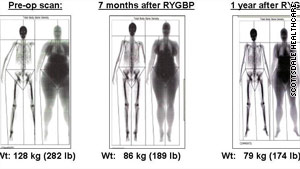
This dexa scan of a woman who underwent bariatric surgery shows where she lost her body fat.

A pear-shaped woman who loses weight will remain a pear, just a daintier one, say researchers who specialize in body fat. More women tend to be pear-shaped, with fat around their hips and thighs. Men tend to be apple-shaped, because they have fat that accumulates around their waist.

"People come in with unrealistic expectations from magazines and spot-reducing," said Gary Foster, director of Temple University's Center for Obesity Research and Education. "That doesn't happen. When you start to lose fat, it's proportionate throughout your body, whether it's your neck, waist, ankle circumference. You'll come out smaller but have the same body shape."
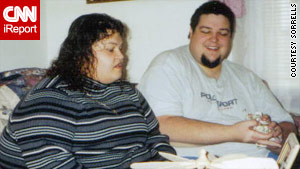
Maggie and Andy Sorrells in 2002, before the couple started a faith-based weight loss program.

That was the case with Maggie Sorrells, 37, who lost nearly 300 pounds through diet and exercise in less than five years.

Her body was pear-shaped even when she weighed about 500 pounds. She reduced her portion sizes and attended weekly faith-based weight loss meetings called Weigh Down. She noticed that her face and hips were getting smaller.

"My hips were like 73 inches," Sorrells said. They're now down to 39 inches.

"It's crazy to think how much they've come down."

See her iReport: Andy & Maggie 550 down

She and her husband, Andy, who live in Nashville, lost more than 500 pounds combined.

Sorrells essentially retained her pear shape, although she's 300 pounds lighter. "I'm still rounder in the bottom part of my body. I'm still pear-shaped," she said.

Maggie Sorrells said she essentially retained her pear shape, although she is 300 pounds lighter.

For most people, the problem is their weight, not their body shape, Foster said. Whether you're a pear or apple may be determined by genetics or hormones.

Not all body fat is created equal.

When Joe Dragon, an insurance company supervisor in Albany, New York, started losing weight from his 425-pound frame, he noticed the biggest difference in his stomach.

"I was never heavy on the bottom; it was more the gut, belly area," the 34-year-old said. "The differences I noticed, I have a flat stomach. It used to be huge round ball."

See his iReport: Joe from Albany

Joe Dragon lost 135 pounds on Weight Watchers and exercise.

Like Dragon, men tend to be apple-shaped and carry more belly fat, known as visceral fat. This is a dangerous type of fat because it surrounds abdominal organs and is metabolically active.

Essentially, it disturbs the regular mechanisms in your body.

The fat cells release biochemicals that lead to inflammation, which could lead to heart attacks, strokes and joint and muscle pain. This accumulates in the liver, said Dr. Robin Blackstone, surgeon and medical director of Scottsdale Healthcare Bariatric Center in Arizona.

"Fat is basically a store of energy," she said. "When you need energy, you break down the fat. That breaks down into a component called free fatty acid and goes into the liver for energy. When you have a lot of excess fat, it generates so much free fatty acid, the liver can't handle it, so it stores it."

That triggers a host of problems including non-alcoholic fatty liver disease, insulin resistance and diabetes.

"Belly fat is much more harmful than the so-called big butt," Foster said.

The fat in the hips causes much alarm because that part of the body is highly visible. Called subcutaneous fat, the masses of this fat may be unsightly, but scientists believe they're not as dangerous as internal abdominal fat.

For cosmetic or social reasons, women are more likely to seek obesity treatment than men.

"What that says is that men are likely to need obesity treatment more than women, but women, likely due to stigma socially for being overweight, are more likely to present for treatment," Foster said.

Where does the fat go?

Fat cells expand when people consume more energy than they can burn. During weight loss, the cells shrink.

"The fat is a very specialized cell, and it takes basically the fat we eat and it stores it in form of triglycerides," said Fried, who researches how fat is deposited. "It's doing that for the purpose of releasing it when other parts of the body need it."

Humans carry about 10 billion to 30 billion fat cells. People who are obese can have up to 100 billion.

"If anyone of us overeats long and hard enough, we can increase the number of fat cells in our body," Fried said. "When we lose weight, we don't lose the number of fat cells."

The size of the cells shrinks, but the capacity to expand is always there.

Liposuction can remove fat cells, but this procedure is ideally for people who are not obese.

"The fat cells are actually being removed," said Tony Youn, a plastic surgeon who performs liposuctions. "It doesn't mean that fat cells that remain can't get bigger."

Despite the extraction of fat cells, the ones remaining can always get bigger or smaller depending on a person's diet and fitness.

Thursday, July 21, 2011

16 Guilt-Free Ways to Enjoy Soda


The Best Natural Sodas: Our Taste Test Results

America's health-conscious crusade against soda has made it crystal clear that we're not supposed to drink the stuff -- it's bad for us, period. But it's important to note that not all sodas are the enemy; mostly just the type laden with high-fructose corn syrup and artificial ingredients. So when you're craving something sweet and sparkly, what to do?
The KitchenDaily editors gathered 16 different brands of all-natural sodas to find the best in a blind taste test. Not a single one of these brands contains high-fructose corn syrup -- most are flavored with cane syrup, agave nectar, or other noted natural sweeteners. With a few exceptions, we were pleasantly surprised by the whole pack of contenders -- and we were happy to find that the two winners (there was a tie!) were unknown to all of us. We're excited to help you discover some new favorites, too!

Comments: "Amazing. So fresh and different. Tastes homey." "The flavors are great, and maybe a little dessert-like." "Spiced apple tasted like apple pie. Yum!" "The Premium Ginger Ale tasted like pumpkin pie spices, and the ginger beer … !!!"

Notable flavors: Premium Ginger Ale, Spiced Apple, Ginger Beer

Wednesday, July 20, 2011

One in 5 restaurant calorie listings is off

One in 5 restaurant calorie listings is off
By Elizabeth Cohen

You think you're being smart when, in an effort to eat more healthfully, you check a restaurant's website to see how many calories are in a dish you plan to order.

It turns out perhaps that effort isn't worth as much as you think. A new study by Tufts University nutrition researchers shows nearly one out of five restaurant dishes has at least 100 more calories than what a restaurant states on its website.

The underestimated foods came from several restaurant chains, including Chipotle Mexican Grill, Olive Garden, Boston Market and Outback Steakhouse.

"I think restaurants have a lot to answer for here," said Susan Roberts, senior author of the paper published in this week's Journal of the American Medical Association.

The study looked at 269 food items at 42 fast-food and sit-down restaurants in Massachusetts, Arkansas and Indiana between January and June 2010. Lead author Lorien Urban, then a Tufts graduate student, and others purchased the foods without telling the restaurants they were for a study. They brought the foods to the lab at Tufts, analyzed the calories and then compared them with the calories listed at that time on the restaurants' websites.

On average, the calorie counts were accurate. However, the lab analysis showed that 19% of the foods tested had 100 or more calories in excess of what was on the website.

"One food had more than 1,000 calories more than it was supposed to," Roberts said, referring to a side order of chips and salsa at On the Border Mexican Grill & Cantina. "It was just shocking."

Sit-down restaurants were more likely to have inaccurate readings. Roberts said she thinks this is because individual workers have some leeway in how they prepare the foods, whereas the process is more automated in fast food restaurants.

In fact, several restaurants have caveats such as the one on the Outback Steakhouse website, which states that "menu items are hand-prepared and caloric values may vary from the stated amount."

A new federal law will require calories to be stated on menus at large chain restaurants in the next year. Due to this new rule, the National Restaurant Association said, "Many restaurant chains are looking at tighter kitchen quality control standards."

The Tufts researchers looked at information on the restaurants' websites, which listed the number of calories absorbed by the body, which is different from the total number of calories in a dish. Using information from the restaurants' websites, the researchers estimated the total number of calories in the food and then tested the food in the lab and made a comparison.

According to the Tufts lab analysis, Chipotle's burrito bowl with rice, black beans, peppers, onions, lettuce, green tomatillo salsa and cheese had 703 total calories -- 249 more than what was expected based on information from the restaurant's website.

In a statement, Chipotle acknowledged there could be calorie differences between what's posted on its website and what's served to customers because of "the seasonality of ingredients, adherence to recipes, and cooking from scratch."

At Olive Garden, Tufts found the chicken and gnocchi soup had 529 calories, which was 246 more than what would be expected based on the restaurant's website.

Olive Garden told CNN the numbers on its website "are as accurate as they can be for dishes that are individually crafted by hand."

At Boston Market, three pieces of dark meat chicken (two drumsticks and a thigh) had 572 calories, according to the lab analysis -- 215 calories more than what would be expected from the restaurant's nutrition information. Boston Market did not respond to CNN's request for comment.

Some foods with the biggest discrepancies were lower-calorie items such as salads, which dieters would be more likely to choose. For example, the Tufts lab analysis showed the classic blue cheese wedge side salad at Outback Steakhouse contained 1,035 calories -- 659 calories more than what would be expected based on what was on the restaurant's website.

Joe Kadow, executive vice president of OSI Restaurant partners, which owns Outback Steakhouse, said he suspected the Tufts researchers tested an entrée-size salad rather than a side salad.

Urban said she's sure she ordered the side salad.

"Looking at it, I think the issue is they put on a lot of dressing -- more than they normally put," she added.

Roberts, author of "The 'I' Diet," said these discrepancies help explain why some people in her diet groups have had trouble losing weight even when they used a restaurant's website to select lower calorie dishes.

"If you have 100 calories more than you think (every day), that's something like 10 or 15 pounds of extra weight you gain over the course of the year," she said.

She advises dieters to order items such as dressing, cheese and sauce on the side, so they can have better control over calories.

Tuesday, July 19, 2011

Power Nutrients You May Not Know

Prebiotics: Power Nutrients You Don't Know About

To reap all the benefits of probiotics, these good bacteria need to be fed correctly. Find out how prebiotics help boost your digestive health.

Medically reviewed by Lindsey Marcellin, MD, MPH
You’ve stocked your fridge with enough probiotics-rich low-fat or no-fat yogurt to feed a small army, but what can aid those “good” bacteria even more? The answer is the nutrient getting a lot of attention recently: prebiotics. A varied diet rich in fruits and vegetables, as well as prebiotic supplements, can support probiotic organisms and other beneficial bacteria in the gut and maximize the benefits of probiotics.
Although the field of research on prebiotics is relatively new, preliminary data suggests that eating foods that contain prebiotics could help anyone feel full longer and manage weight more effectively, as well as helping women maintain healthy bones.
You may already know about probiotics: If your doctor gives you a hefty antibiotic and recommends that you eat yogurt or take a probiotic supplement, that’s to restock the “good” bacteria in your gut that help the digestive process.
Recently, nutrition experts and physicians have been exploring what these good bacteria need to remain effective, and the answer seems to be prebiotics.
Prebiotics: Form and Function
Your intestines are inhabited by many kinds of bacteria, many of which help you stay healthy and also help you digest your food efficiently. When you eat digestion-friendly foods containing prebiotics, the digestive process creates an atmosphere that favors the probiotics you are eating in that yogurt. This shifts the balance toward the good bacteria, which can boost your digestive health.
“Prebiotics are a special form of dietary fiber that are available in plant foods, such as onions, leeks, and bananas,” says Shannon Rentz, RD, LD, adult clinical outpatient dietitian at Oregon Health Sciences University in Portland. “The prebiotics help work with probiotics to keep the chain of events going. They are the fuel for the probiotic bacteria’s growth.”
Getting Prebiotics Into Your Diet
You have two options for adding prebiotics to your diet: Eat them naturally in whole fruits and vegetables, or take a prebiotic supplement. “As with all nutrients, dietitians recommend always trying to get prebiotics from food first,” says Rentz.
Foods that contain fiber which acts as prebiotics include:
  • Artichokes
  • Jerusalem artichokes
  • Leeks
  • Onions
  • Garlic
  • Wheat
  • Oats
  • Soybeans
The more varied the fruits and vegetables you include in your diet, in combination with probiotic-rich yogurt, the better your digestive balance is going to be. “That’s why experts encourage five servings of fruits and or vegetables a day as a minimum,” says Rentz.
Many gastroenterology practices offer their own prebiotic supplement formulas, and you can find them online as well. However, prebiotic supplements can be pricey, ringing in at about $40 on average for a month’s supply, says Rentz.
For an added boost to your digestive health, incorporate more foods with prebiotics into your diet, along with probiotic-friendly yogurt. Together, prebiotics and probiotics pack a one-two punch for your health.

Monday, July 18, 2011

Jonah Hill Shows Off Dramatic Weight Loss

Jonah Hill Shows Off Dramatic Weight Loss
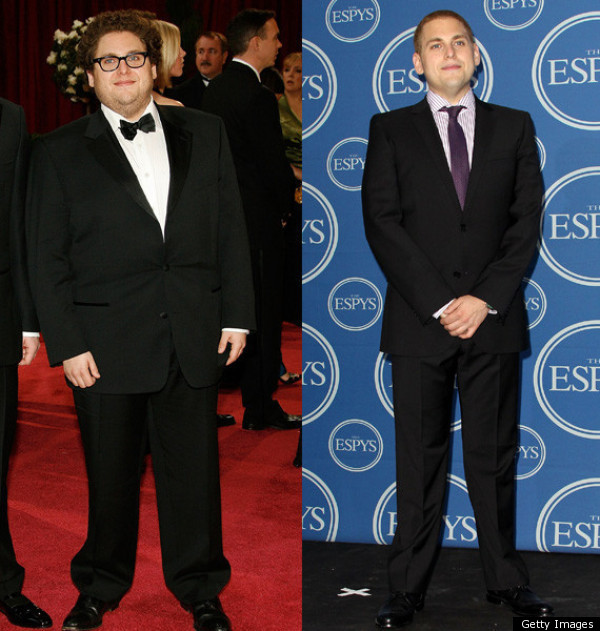
It's no secret that Jonah Hill has been working hard to shed some weight, and the '21 Jump Street' star showed off a svelte new figure at the ESPY Awards Wednesday night.
Earlier this spring, it was reported that Hill set a goal to shed 30 pounds for his demanding role in the action-packed '21 Jump Street,' and it looks like he achieved -- if not surpassed -- that goal.
According to Us Weekly, the actor gained weight when he first started training for the role, but once he teamed up with a nutritionist and trainer, the weight started coming off.
'21 Jump Street,' which also stars Channing Tatum, is slated for a March 2012 release.
Jonah Hill Weight Loss

Friday, July 15, 2011

Who Should Eat Gluten-Free Food?

Who Really Should Be on a Gluten-Free Diet?

It's no question that people with celiac disease and gluten sensitivity feel better on a gluten-free diet, and it's becoming increasingly popular in the mainstream as well. But sticking with a truly gluten-free diet is challenging. Find out if going "g-free" is right for you.

A gluten-free diet is as trendy as the latest purse. Elisabeth Hasselbeck, co-host of "The View," wrote a book about it — G-Free Diet: A Gluten Survival Guide — and even celebs with no known gluten sensitivity, like Gwyneth Paltrow and Oprah Winfrey, swear by it for the health benefits and detox effects.
For people who have celiac disease or gluten sensitivity like Hasselbeck, it can make a significant difference in quality of life. For that relatively small group of people, a gluten-free dietfunctions as a detox diet by relieving their system of an irritant.
For people who aren't fighting gluten sensitivity, avoiding gluten is not a health necessity, but it can be a way to construct a new diet. In fact, if you decide to go gluten-free and you aren't gluten sensitive, you could find that you feel better just because you are eating more healthfully.
A gluten-free diet is a return to foods that are good for you, says Shannon Rentz, RD, LD, adult clinical outpatient dietitian at Oregon Health Sciences University in Portland. "Fruits, vegetables, rice, corn — all those are healthy."
When a Gluten-Free Diet Is a Must
People who need to go on a gluten-free diet usually have one of these conditions:
  • Celiac disease. People who have celiac disease actually have damage to villi (tiny fingerlike tissues that aid in digestion) in theirdigestive tract because of the chronic inflammation caused by gluten. When they eat even a tiny amount of gluten, they experience symptoms such as bloating, cramping, or specific types of skin rashes. People with celiac disease might also become lactose intolerant and have iron deficiency anemia, says Rentz. Celiac disease is diagnosed using blood tests and a small bowel biopsy. About 1in 133 people has celiac disease, according to the National Institutes of Health.
  • Gluten intolerance or sensitivity. People with non-celiac gluten sensitivity do not have damage to their intestinal lining. However, they experience headaches, bloating, fatigue, or diarrhea after eating foods containing gluten. As a result, they find that a gluten-free diet improves the quality of life. It's hard to get a good estimate on the number of people with gluten sensitivity. It's more common than celiac disease and probably more common than we know — possibly as many as one in 10 people.
"If you suspect gluten's a problem, you should still eat the foods that contain gluten and ask for a blood test," says Rentz. If you stop eating gluten foods before the blood test, the results will be normal. She stresses that before she helps clients construct gluten-free diets, she wants them to go through all the testing and get a proper diagnosis to know if they have to be "100 percent compliant," she says.
The good news for people who are going gluten-free is that they have more options than ever before. "There have never been more products available for the consumer," she says, adding that in many major urban areas restaurants are increasingly catering to gluten-free diet needs. As always, it is important to read labels because even products like soy sauce can contain gluten. Also keep in mind that "wheat-free" doesn't mean gluten-free, reminds Rentz. And just because a product is gluten-free doesn't mean it is also going to meet your dietary needs for nutrients or that it is low calorie, low fat, or low sodium.
For people with celiac disease, your entire kitchen may need to be revamped because cross contamination from cooking instruments, pots, and pans that have been used for gluten-containing foods can cause symptoms. "This is a very difficult life change for people," says Rentz.
People with gluten sensitivity can occasionally have small amounts of gluten-containing foods if they aren't too troubled by the symptoms this causes.
When a Gluten-Free Diet Is a Choice
Certainly, you can try a gluten-free diet even if you don't medically need to do so. If you focus on a wide variety of whole foods such as fruits, vegetables, lean meats, dairy, and non-gluten grains like quinoa, you can probably build a diet that is healthy and nutritious, but skip the usual suspects — wheat, rye, and barley — that provide gluten. However, if you don't have a gluten sensitivity, then a gluten-free diet isn't a "detox" diet because gluten isn't a toxin for your system.
Also, says Rentz, one of the most surprising signs of a gluten sensitivity or celiac disease is a lack of iron due to poor absorption, and this can also be a problem for people who rely too heavily on prepackaged gluten-free products that might not provide you with all the nutrients you need. So giving up gluten when you don't have to for medical reasons means you may be giving up vital nutrients in the process. Read labels and consider a daily multivitamin supplement if you decide to try eating gluten-free.
Another drawback, especially for those who aren't celebrities, is that gluten-free foods can be costly.
So if you haven't been diagnosed with celiac disease or gluten sensitivity, it's okay to buck the gluten-free diet trend — you don't have to cut out gluten because the stars are doing it. Do drop gluten if you are having a reaction to it, but only after seeing your doctor and getting the testing needed for a diagnosis.

Thursday, July 14, 2011

What That Heartburn May Really Mean

Recognize the Symptoms of GERD

Symptoms of GERD can interfere with your quality of life. You can ease symptoms and lessen your chances of reflux with medication and lifestyle changes.

Medically reviewed by Niya Jones, MD, MPH
You’ve just finished a delicious meal, but instead of feeling satisfied, you’re quite uncomfortable — there’s a burning sensation in your stomach moving up toward your chest and throat, and it may get worse when you lie down. What’s going on?
You may be experiencing gastroesophageal reflux disease, or GERD, a condition in which stomach acid backflows into the esophagus, an event also known as acid reflux. This acid irritates the lining of the esophagus, leading to a number of uncomfortable symptoms. If left untreated, GERD can cause serious complications.
GERD Symptoms
The main symptom of GERD is heartburn, a painful, burning sensation that begins in the stomach and spreads upward through your chest and throat. Heartburn usually occurs after a big meal or an activity that encourages stomach acid to move up into your esophagus. Heavy lifting, bending over, or lying down can all trigger acid reflux.
People with GERD may notice particularly intense heartburn symptoms at night. Keep in mind, however, that the amount of pain doesn't necessarily correlate with the degree of underlying damage being done. In some people, GERD can lead to serious, long-term damage to the esophagus despite few symptoms, while others may experience severe heartburn with minimal esophageal irritation.
Besides heartburn, other common GERD symptoms in adults include:
  • Dyspepsia. Also known as indigestion, dyspepsia leads to stomach discomfort or pain. People with dyspepsia may also feel nauseated after meals.
  • Acid regurgitation or reflux. People may note a sour taste due to stomach acid flowing into their mouths. This symptom may be accompanied by uncomfortable belching.
  • Chest pain. Some people with GERD report feeling like food is stuck in their chest adjacent to the breastbone.
  • Throat problems. GERD can cause irritation of the throat and airways, leading to sore throat, hoarse voice, dry cough, or a sensation of a lump in the throat. As a result, people with GERD may feel the need to clear their throat often.
  • Chronic nausea. GERD can sometimes cause nausea that lasts for months. Excessive acid reflux can lead to vomiting as well.
GERD Symptoms in Children
GERD can occur in infants and children, but it may be hard for parents to recognize the symptoms. Most young children don't experience heartburn as a result of GERD reflux, but instead display a set of symptoms very different from those of adults. These symptoms include:
  • Frequent regurgitation, "wet burps," or vomiting, especially after meals
  • Persistent coughing or wheezing
  • Difficulty swallowing
  • Failure to thrive or gain weight
  • Refusal to eat food
  • Irritability
Some of these symptoms can occur in infants as a result of other problems besides GERD, including food allergies, respiratory disorders, and even the normal teething process, but GERD should be considered as a potential contributory factor.
The weight and other growth parameters of babies and small children with these symptoms should be monitored closely to prevent complications such as anemia and other nutritional deficiencies.
Managing GERD Symptoms
People with mild GERD symptoms like heartburn may find that over-the-counter (OTC) antacids help offset their symptoms. Other OTC medications like the H2 blockers famotidine (Pepcid) and cimetidine (Tagamet) and proton pump inhibitors such as omeprazole (Prilosec) may be useful if antacids don't help.
But if you find yourself popping more and more antacids or other OTC medications, talk to your doctor about your symptoms. Stronger medications available by prescription can be used to alleviate your symptoms. Or your doctor may perform special tests to figure out whether another condition is causing your symptoms.
There are also a number of lifestyle changes you can make to lessen or eliminate GERD symptoms:
  • Avoid foods that irritate the stomach and may promote reflux. These include foods with caffeine, spicy foods, chocolate, peppermint, fried foods, and acidic foods.
  • Don't lie down for about three hours after you eat.
  • Quit smoking and limit or eliminate alcohol intake.
  • Lose weight.
  • Raise the head of your bed about half a foot by placing blocks under the headboard. This elevates your upper body and discourages acid reflux. Keep in mind that extra pillows won't do the trick.
GERD can be painful, but the good news is you don’t have to live with the pain. Talk to your doctor about medications and try these lifestyle changes to lessen — and even prevent — your symptoms.